
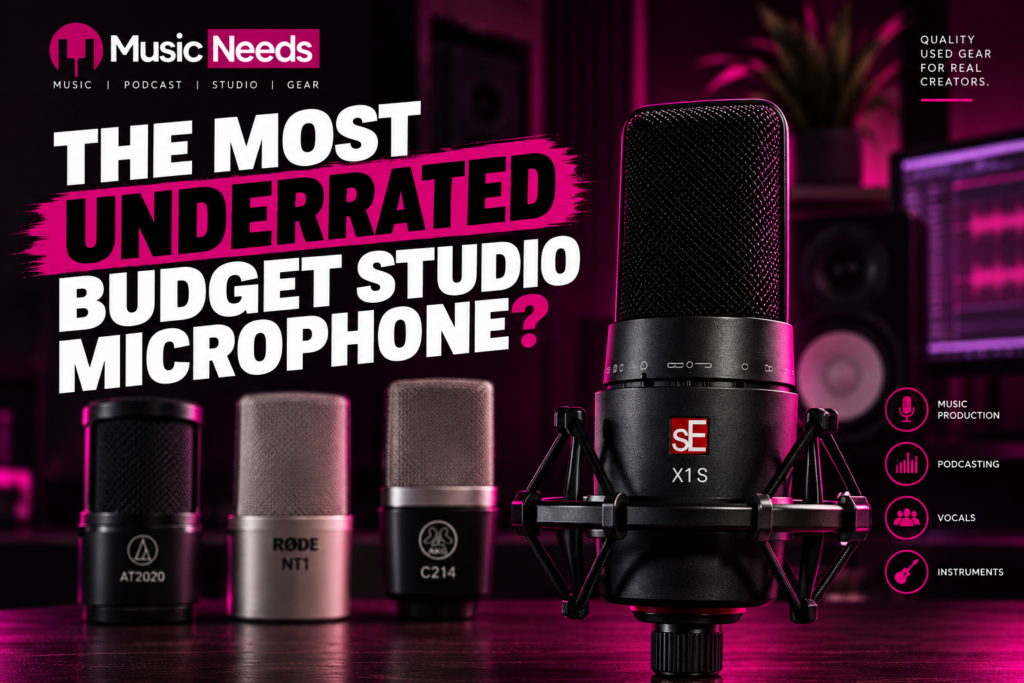
You’ve probably heard of the Audio-Technica AT2020.
You’ve probably heard of the RØDE NT1.
And if your budget is a little higher, you’ve probably come across microphones like the AKG C214.
But there’s another microphone that doesn’t seem to get nearly as much attention from everyday buyers:
The sE Electronics X1 S.
And the more I see this microphone being used in actual recording environments, the more I wonder why it isn’t talked about more.
Why I Started Paying More Attention to the X1 S
I’ll be honest: I didn’t originally think of the X1 S as some secret weapon of the studio world.
Like many people, when I first saw the X1 S, I saw the familiar X1 design and immediately associated it with the X1 A.
They’re both part of the X1 family.
They look similar.
And from a distance, it’s easy to assume they’re basically the same microphone.
But they’re not.
The X1 S was redesigned with a hand-crafted 1-inch true condenser capsule and redesigned electronics, along with significantly lower self-noise, higher sensitivity and much greater SPL handling. (sE Electronics)
And then I started noticing something interesting.
I’ve Actually Seen Professionals Using It
One of the things that changed my perspective on the X1 S was attending a Dolby training session.
During the session, the sound professional who was teaching us mentioned that he used an sE Electronics X1 S.
That caught my attention.
Not because someone saying they use a microphone automatically makes it better.
But because it made me think:
Why are we sometimes treating this microphone like it’s just another entry-level condenser when people working professionally are actually using it?
And I’ve seen something similar since then.
We’ve also come across people selling recording equipment where it’s clear that the equipment has been used in a serious recording environment — and once again, an X1 S was part of the setup.
That doesn’t mean every professional studio uses an X1 S.
It doesn’t mean it’s automatically better than an AT2020, NT1 or C214.
But it does make the microphone worth looking at more closely.
The X1 S Is Probably More Appreciated by Professionals Than Its Reputation Suggests
This is where I think the X1 S gets interesting.
There seems to be a disconnect between how the microphone is perceived and what the microphone actually offers.
A casual buyer might see:
“sE X1 S — budget condenser.”
A person who actually looks at the microphone’s specifications sees something quite different.
The X1 S has:
- A 1-inch hand-crafted true condenser capsule
- 9 dB equivalent noise
- Up to 160 dB SPL handling
- -10 dB and -20 dB attenuation
- 80 Hz and 160 Hz low-cut filters
- 30 mV/Pa sensitivity
- 131 dB dynamic range without attenuation
- An all-metal chassis
- Gold-plated XLR connector
These are official sE Electronics specifications. (sE Electronics)
And that’s a pretty serious specification sheet for an affordable condenser microphone.
The Biggest Problem? It Looks Too Familiar
I think this is one of the reasons the X1 S gets overlooked.
The microphone doesn’t look dramatically different from the X1 A.
So someone who isn’t familiar with the two microphones might see them sitting next to each other and think:
“They’re basically the same thing.”
But the X1 S isn’t simply an X1 A with a nicer package.
The X1 S has a different capsule design and redesigned electronics.
The difference becomes much clearer when you look at the specifications.
| Feature | X1 A | X1 S |
|---|---|---|
| Capsule | 2/3″ Back-Electret Condenser | 1″ Hand-Crafted True Condenser |
| Equivalent Noise | 16 dB | 9 dB |
| Sensitivity | 20 mV/Pa | 30 mV/Pa |
| Attenuation | -20 dB | -10 / -20 dB |
| Low-Cut | 100 Hz | 80 / 160 Hz |
| Maximum SPL | Up to 150 dB | Up to 160 dB |
| Dynamic Range | 114 / 134 dB | 131 / 141 / 151 dB |
That’s not a minor accessory upgrade.
The microphone itself is different.
And That’s What Makes the X1 S So Interesting
The X1 S isn’t trying to be a Neumann.
And it doesn’t need to be.
The interesting thing about the X1 S is that it gives you a lot of the functionality you actually want from a serious studio condenser without pushing you into the price range of high-end microphones.
It’s designed for:
- Vocals
- Acoustic guitar
- Electric guitar cabinets
- Drums
- Overheads
- Piano
- Strings
- Brass
- Woodwinds
- Room recording
sE Electronics specifically lists these applications for the X1 S. (sE Electronics)
That’s quite a bit more versatile than simply calling it a “budget vocal microphone.”
X1 S vs the Microphones Everyone Talks About
This is where the conversation gets interesting.
Audio-Technica AT2020
The AT2020 is one of the best-known entry-level condenser microphones.
It’s affordable, widely available and extremely familiar to home-studio users.
That’s part of what makes the X1 S interesting.
The X1 S doesn’t have anywhere near the same level of mainstream recognition, yet it offers features such as switchable attenuation and two low-cut settings.
RØDE NT1
The NT1 is another microphone that is very well known among home-studio producers and vocalists.
Its low-noise performance is one of its major attractions.
The X1 S is also designed around low self-noise, with sE specifying just 9 dB equivalent noise. (sE Electronics)
So the X1 S shouldn’t automatically be dismissed as the cheaper alternative.
It deserves to be considered on its own merits.
AKG C214
The C214 is a different category in terms of pricing.
It’s more of a step-up microphone for someone who is prepared to spend more on their recording chain.
That’s why I wouldn’t describe the X1 S and C214 as direct equivalents.
But the C214 is useful as a comparison because it shows the kind of microphone people start looking at when they move beyond basic entry-level recording.
And the X1 S sits in an interesting position underneath that level.
The X1 S Studio Bundle Makes It Even More Interesting
There’s another reason people might misunderstand the X1 S.
The X1 S Studio Bundle comes with much more than the microphone.
It includes:
- X1 S microphone
- Shockmount
- Metal pop filter
- 3-metre XLR cable
- RF-X Reflexion Filter
sE Electronics describes the bundle as a complete recording setup for applications including vocals, acoustic guitar, guitar cabinets, overheads, piano, percussion and more. (sE Electronics)
But don’t let the bundle distract from the important part.
The X1 S itself is the interesting piece.
The reflection filter didn’t give it its 1-inch capsule.
The shockmount didn’t give it its 9 dB self-noise.
And the cable didn’t give it its 160 dB SPL capability.
Those characteristics are part of the microphone.
Maybe the X1 S Is Underrated by the Wrong Audience
This is probably the biggest point I want to make with this article.
The X1 S might not necessarily be unknown to professionals.
It may actually be more appreciated by people who work with recording equipment than by the average consumer shopping for their first microphone.
And that creates an interesting situation.
The people who know what they’re looking at may recognize the value of the X1 S.
Meanwhile, someone shopping for a budget microphone might scroll straight past it because they’ve heard of the AT2020 or NT1 more often.
That’s what makes it underrated.
Not necessarily because nobody knows about it.
But because its reputation among the general buying audience may not reflect what the microphone is capable of.
It’s Not About Saying the X1 S Is “The Best”
I don’t think that’s the right argument.
Microphones are tools.
The best microphone depends on the vocalist, instrument, room, recording technique, preamp, placement and the sound you’re trying to achieve.
An AT2020 might be exactly what someone needs.
An NT1 might be the right choice for someone else.
Someone else might prefer a C214.
And someone working in a very high-end studio might have access to microphones costing several times more.
The point isn’t that the X1 S replaces all of them.
The point is that it deserves to be part of the conversation.
So, Is the X1 S the Most Underrated Budget Studio Microphone?
I think it has a very strong case for that title.
It’s affordable.
It’s versatile.
It has a hand-crafted 1-inch true condenser capsule.
It has extremely low specified self-noise.
It can handle very high SPL.
It gives you both attenuation and low-cut options.
And, perhaps most importantly, I’ve encountered it being used in professional recording contexts when I wasn’t expecting to see it.
That changed how I looked at the microphone.
Maybe the X1 S isn’t the microphone everyone talks about.
Maybe that’s exactly why it’s worth talking about.
The X1 S deserves a second look.
The next time you’re shopping for a budget studio condenser, don’t just look at the microphones you’ve heard about the most.
Look at the specifications.
Look at how the microphone is actually being used.
And don’t assume that because the X1 S looks like an X1 A, they’re basically the same microphone.
The X1 S is a much more serious microphone than its appearance — and its reputation — might suggest.
What do you think?
Have you used an sE Electronics X1 S in your studio?
Have you compared it with an AT2020, RØDE NT1 or AKG C214?
Let us know what you think.
Sources
Technical specifications and product information are based on sE Electronics’ official X1 S documentation and product pages. (sE Electronics)